You’re still a toddler in the study-abroad race, and the January 2026 intake is standing tall right in front of you. The same questions are probably hitting your head on repeat: cost, affordability, fees, and most importantly, ROI. This blog is designed to help you plan smart without burying you under years of education loans.
At iKounselor, we believe studying abroad isn’t just about collecting destination stamps. It’s about smart budgeting, meaningful choices, and real returns. So welcome to your Jan 2026 crash guide, where planning meets possibility, and value meets adventure.
We call it your “Cost-to-Work Plan.” Because the goal isn’t just finding the right country; it’s having a foolproof roadmap that leads to a future that pays you back, not just hands you a degree.
Book a Free Consultation with our Experts Now!
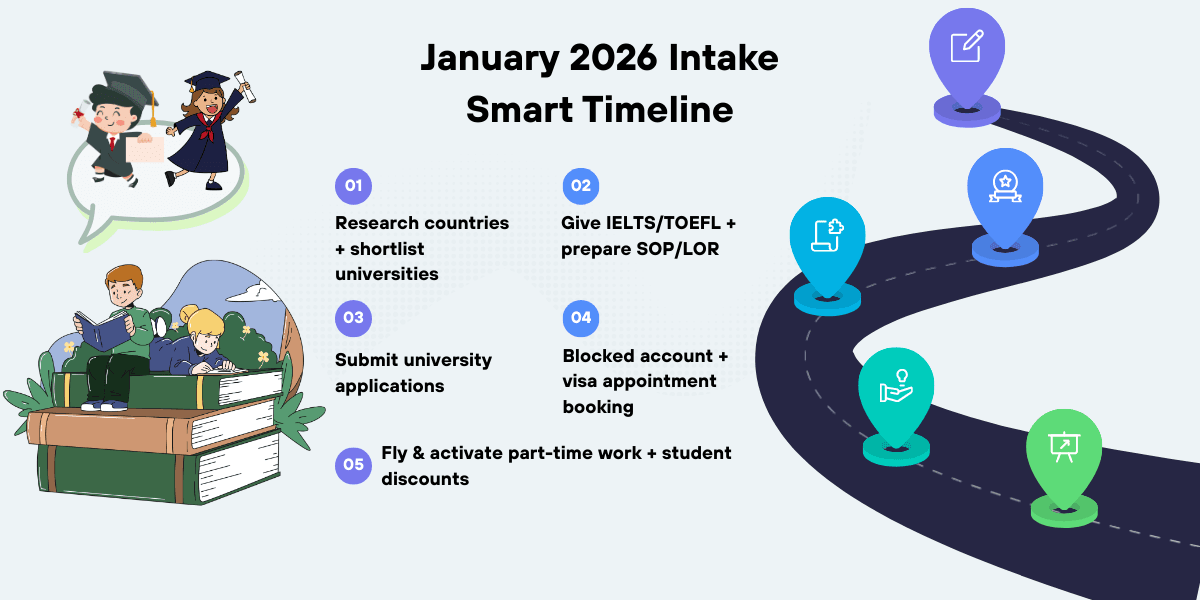
January 2026 Intake: Smart Timeline
- Research countries + shortlist universities
- Give IELTS/TOEFL + prepare SOP/LOR
- Submit university applications
- Blocked account + visa appointment booking
- Fly & activate part-time work + student discounts
Why Value & ROI Matter for 2026 Applicants?
With the ocean of information available on the internet today, students are more informed and aware. They are looking beyond prestige and considering factors like:
- Low tuition fees
- Affordable living
- Post-study work rights
- Job-opportunity potential after studies
- Student discounts
- Political scenario
- Safety
- Accommodation, etc
It is quite evident that for Jan 2026 applicants must choose their study destination with an eagle eye. This will surely save you from a wrong investment.
As per the experts with a valued experience of more than 25 years, a study destination that is booming is Germany. It is definitely going to top every list of the best countries to study abroad in 2026.
A Closer Look at a Popular Option: Germany
Free education, student-friendly and culturally rich Germany has a lot to offer to international students. Let’s look at the green flags to study in Germany :
- Tuition Fees: Most public universities do not charge tuition for bachelor’s and many (not all) master’s programmes for international students.
- Semester / Administrative Fee: You pay a “semester contribution/fee” (Semesterbeitrag), typically between €150 – €350 per semester (₹13,000 – ₹32,000 depending on exchange rate).
- Living Costs: Students should budget around €900 – €1,200/month, but this varies significantly by city and lifestyle.
- Visa Requirement Update (Important for 2026): For a German student visa, proof of funds is mandatory. The current standard for blocked accounts is approximately €992/month (€11,904/year), and this is expected to remain close to this range for 2026 applications.
- Student Work Rules: 120 full days or 240 half-days per year allowed (standard regulation).
- Post-Study Window: 18-month job-seeker permit remains accurate.
Why does this matter to study in Germany?
For many Indian students, this means almost zero or very low tuition, manageable monthly living costs, and an opportunity to earn. Ultimately, making Germany a top candidate under iKounselor’s “Cost-to-Work Plan”.
Top Affordable Picks for Jan 2026 (Cost + ROI at a glance)
Germany
- Tuition: No/very low tuition in public universities
- Mandatory Cost: €150 – €350/semester administrative fee
- Living Cost: €900 – €1200/month depending on city choice
- Student Work: 120 full days or 240 half-days per year allowed
- Post-study Window: 18-month job-seeker permit
- ROI Strength: High earning potential, strong job market in engineering, tech and sciences
- Scholarships: DAAD and state-funded study grants popular for Indians
Poland
- Tuition: Typically ranges from €1,500 – €4,000/year for many public programmes (private universities may charge more).
- Living Cost: Approx €350 – €700/month (₹32,000 – ₹65,000 depending on city and accommodation type).
- Student Work: Part-time work allowed, restrictions may apply per visa category
- Post-study Stay: 9 – 12 months temporary permit based on job offer, varies by case
- ROI Strength: European exposure + low cost balance = High for budget planners
- Scholarships: Government & University grants available
Malaysia
- Tuition: Public universities often range from RM 7,000 – RM 15,000/year for many programmes (private institutions can cost more depending on the course).
- Post-study Trend: Growing sectors in data, hospitality, finance, and engineering support roles and a stay option.
- Student Work: Conditional allowance should always be verified with the university's international office.
- Post-study Trend: Growing sectors in data, hospitality, finance, and engineering support roles.
- ROI Strength: Medium to High if targeted to rising job sectors at the university.
- Scholarships: Institutional scholarships are available.
Why “Affordable” doesn't mean “Low Quality”? What to Watch Out For?
- Even tuition-free public universities may charge semester fees or small admin fees. That’s normal.
- Cost of living varies by city, big cities like Munich, Frankfurt tend to be expensive; smaller towns are much more budget-friendly.
- A blocked account or proof of funds is mandatory for a visa application. As per DAAD, you must show sufficient funds (for example, ~€992/month) to prove you can cover living expenses.
- You can’t rely only on part-time work, treat any income as supplementary. Plan the budget accordingly.
Intake months are NOT uniform. Many universities may not offer a January intake. Always confirm intake availability based on the university & programme calendar.
How iKounselor’s Cost-to-Work Plan Makes It Even Smarter?
If you pick Germany for Jan 2026 and plan smart, you can:
- Save heavily on tuition (public unis).
- Control monthly expenses by selecting shared flats or smaller cities.
- Use part-time work, student discounts & local transportation pass. (often included in semester fee) to manage living costs.
- Explore scholarships (via DAAD or other funding bodies) to further reduce costs.
That way, studying abroad becomes an investment that pays you back, not a debt you pay forever.
Final Thoughts: Is Jan 2026 Your Ticket to an Affordable + High-Value Study Abroad?
Absolutely. Our study abroad experts at iKounselor suggest that with smart planning, you can pick a country that:
- Doesn’t burn a hole in your pocket every semester
- Let's you live reasonably (not like you’re surviving but not splurging either)
- Gives you a real shot at good ROI work opportunities, quality education, plus manageable expenses
At iKounselor, we’re all about making study abroad smart & sustainable. Get your personal study abroad plan crafted as per your profile, budget and dreams. Don't trust our words, our students talk on our behalf. Do check our YouTube and Instagram for the value that you are looking for.
FAQs: January 2026 Intake, Affordability & ROI
- Which are the cheapest countries to study abroad for the January 2026 intake?
Germany, Poland, and Malaysia are consistently considered budget-friendly due to low or no tuition and student-manageable living costs.
- Is the January 2026 intake suitable for Indian students on a tight budget?
Yes. The January intake offers flexible admissions and good scholarship availability, making it a solid option for students planning an affordable education.
- What is a good ROI when studying abroad in 2026?
A good ROI means low education cost, controlled living expenses, part-time work support, and strong post-study earnings or job potential in your field.
- How much should students budget monthly for living abroad in 2026?
It depends on the country and city, but choosing shared accommodation and student transport passes can reduce monthly expenses significantly.
- Can part-time work really improve affordability for the January 2026 intake students?
Yes, in countries like Germany and Poland, part-time student work opportunities help support living costs and improve overall ROI planning.
- Does iKounselor charge consultancy fees for intake planning?
No. iKounselor offers zero consultancy fee counseling and university shortlisting for students targeting the Jan 2026 study-abroad intake.


.jpg&w=3840&q=75)
.jpg&w=3840&q=75)
.jpg&w=3840&q=75)